 ®
®Rooftop vs Split-System: Which Commercial Air-Conditioner Fits Your Premises?
Rooftop vs split system commercial air conditioning. What is the right for your business? 1. Quick Comparison Table Feature Rooftop Package Unit Commercial Split System Typical ...
Introduction
Rooftop vs split system commercial air conditioning. What is the right for your business?
1. Quick Comparison Table
Feature Rooftop Package Unit Commercial Split System Typical capacity 10 kW – 300 kW single footprint 7 kW – 25 kW per indoor head Best for Warehouses, retail, large open-plan Tenancies, offices, server rooms Install cost Higher crane & roof works Lower hardware, more indoor works Space impact Saves indoor floor space Requires indoor ceiling/wall space Service access Easy (roof) but needs height safety Ladders + inside ceiling tiles Energy efficiency High with VSD & economiser High with inverter compressor Noise Minimal indoors Possible indoor fan noise
2. What Is a Rooftop Package Unit (RTU)?
A rooftop unit is a single, factory-built HVAC package that sits on the roof. It houses compressor, evaporator, condenser, and supply/return fans in one weather-tight cabinet. Supply and return ductwork penetrate the roof to serve the occupied area below.
Pros
- All-in-one footprint makes installation quick.
- Frees up valuable floor area for revenue-earning use.
- Easy to service without disrupting tenants.
- Built-in economisers can use free cooling on mild nights.
Cons
- Crane lift can add $3 000–$10 000 to install.
- Exposed to salt and UV—requires quality coating.
- Long duct runs can create static-pressure losses if badly designed.
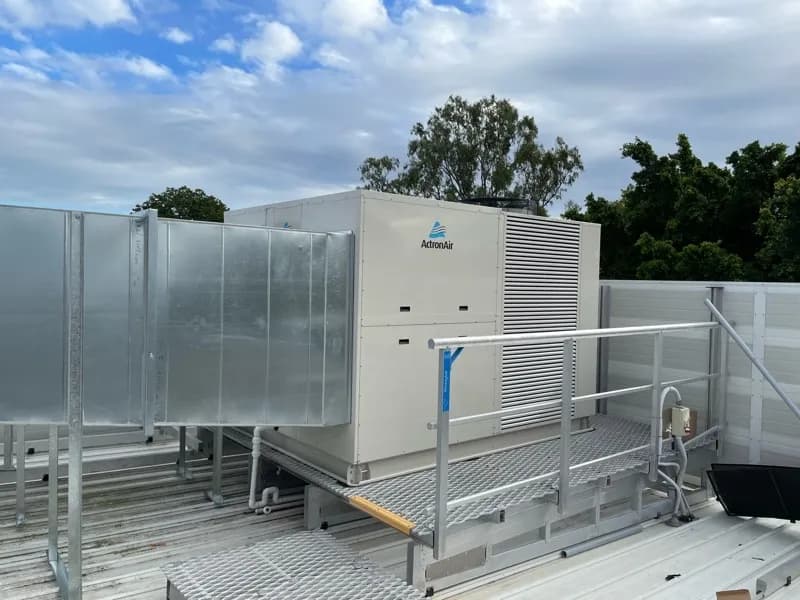
[caption id="attachment_5098" align="alignnone" width="800"]
A high-efficiency rooftop package unit (RTU) frees up floor space and allows easy service access—ideal for large open-plan commercial sites.[/caption]
3. What Is a Commercial Split System?
A split system separates the outdoor condenser from one or more indoor fan-coil units. Refrigerant lines run between them. Commercial-grade splits start at 7 kW and go up to ~25 kW per head; multiple heads can serve zones independently.
Pros
- Lower up-front equipment cost.
- Energy-efficient inverter compressors.
- Flexible zoning—cool offices and meeting rooms separately.
- Easier to retrofit where roof space is restricted.
Cons
- Indoor units consume ceiling/wall real estate.
- Drainage piping through ceiling voids needs fall and insulation.
- Multiple condensers can clutter façades if not planned.
4. Six Factors to Help You Decide
4.1 Building Size & Layout
- < 500 m² with internal partitions → split systems or VRF.
- > 500 m² open warehouse/retail → rooftop package.
4.2 Roof Structure & Crane Access
Steel portal frames and flat roofs take RTU weight easily. Heritage roofs? Go split.
4.3 Installation Budget vs Life-Cycle Cost
Splits cost ~15 % less in hardware but can run extra refrigerant piping and future maintenance. RTU cranes are expensive up-front but lower long-term service costs.
4.4 Energy Efficiency Targets
- RTU with economiser + VSD fans can reach COP > 4.0.
- Split with high-SEER inverter hits COP 3.5–4.2, great for small zones.
4.5 Maintenance Access & Tenant Disruption
RTU: techs work outside, zero disruption. Splits: quarterly filter changes above desks; schedule after hours.
4.6 Future Expansion
RTU capacity upgrades mean swapping one unit. Splits: add another head/compressor pair, but pipework limits may apply.
5. Real-World Case Studies
Case 1 — Yatala Logistics Warehouse (2 000 m²)
A client installed two 85 kW RTUs with duct sox. Result: 18 % lower operating cost vs multiple splits, zero floor-space loss.
Case 2 — Surfers Paradise Boutique Hotel (30 rooms)
Replaced ageing RTUs with 14 high-SEER split systems for zoning per room. Guests now control their own climate; electricity use down 12 %.
6. Frequently Asked Questions
Which system is cheaper to maintain?
- RTUs centralise components—one set of filters, belts, and coils—generally reducing annual service labour by 10–20 % compared with many split units.
Do rooftop units need planning approval?
- In Queensland most roofs allow RTUs under “minor mechanical plant,” but councils may require development approval in noise-sensitive zones.
Can you mix both systems?
- Yes—common in large retailers: RTU for shop floor, splits for offices and server rooms.
- Acro designs hybrid solutions.
7. Book a Free Cooling Audit
Not sure which HVAC option fits your site? Our engineers model load profiles, roof loads, and ROI—free across Brisbane, Logan, and the Gold Coast.
📞 1300 227 600 • Request your audit →
🔄 Stay Connected
Follow us on Facebook, or LinkedIn for the latest updates on commercial refrigeration tips and industry news.
📰 Enjoyed this article?
Browse more helpful insights and case studies on our Refrigeration Blog
Areas We Service — Commercial Air-Conditioning & Refrigeration
Gold Coast
- Southport CBD & Chinatown Precinct
- Surfers Paradise & Chevron Island
- Broadbeach (Convention Centre & restaurant strip)
- Robina & Varsity Lakes Business Parks
- Burleigh Heads & Burleigh West Industrial Estate
- Molendinar / Ashmore Industrial Area
- Nerang & Carrara Trade Precincts
- Arundel & Parkwood light-industrial zones
- Helensvale Town Centre & Westfield
- Coomera Marine & Theme-Park Corridor
- Yatala / Ormeau / Stapylton Enterprise Area
- Currumbin Waters & Southern Gold Coast Airport Precinct
Brisbane
- Brisbane CBD & Queen St Mall
- Fortitude Valley, Newstead & Teneriffe riverside precincts
- South Brisbane, West End & Woolloongabba stadium corridor
- Milton, Toowong & Indooroopilly commercial hubs
- Bowen Hills, Albion & Breakfast Creek Road showrooms
- Eagle Farm, Hamilton & Pinkenba TradeCoast logistics zone
- Northgate, Virginia, Banyo & Geebung industrial estates
- Chermside & Aspley retail/commercial centres
- Rocklea, Acacia Ridge & Cooper Plains freight precincts
- Salisbury & Mount Gravatt enterprise corridors
- Eight Mile Plains & Brisbane Technology Park
- Murarrie, Cannon Hill & Port of Brisbane corridor
- Wynnum–Manly & Gateway East Trade Precinct
- Capalaba & Redlands light-industrial area
- Brendale & Strathpine business parks
Logan & Southern Corridor
- Springwood & Slacks Creek motor-retail strip
- Underwood & Kingston industrial estates
- Meadowbrook Health & Education Precinct
- Logan Central & Woodridge retail hubs
- Loganholme, Tanah Merah & Shailer Park commercial zone
- Berrinba Logistics Estate & Crestmead Industrial Park
- Beenleigh & Yatala South enterprise area
- Park Ridge, Browns Plains & Hillcrest trade centres
- Yarrabilba town centre
“Need service outside these suburbs?Call 1300 227 600— our technicians travel wherever Queensland businesses need reliable air-conditioning and refrigeration support.”
Need expert advice for your business?
Our technicians are available 24/7 for emergency repairs, preventative maintenance and cold room builds across Brisbane, Gold Coast and the Sunshine Coast.
Refrigeration Emergency? We're On Call 24/7.
Don't lose stock to a breakdown. Call now or book a maintenance plan to prevent it happening in the first place.