 ®
®Smart Monitoring
IoT-enabled temperature monitoring with real-time cloud dashboards, automated alerts and continuous HACCP logging. Know about problems before your stock is at risk.
From fault to response — the alert workflow that prevents stock loss
Smart monitoring is only as valuable as what happens after the alert. This is exactly how a temperature excursion at 2am plays out with ACRO monitoring in place — versus without it.
Without monitoring — discovered at opening
Fault develops overnight
Compressor fault at 11pm. Cool room temperature begins rising. No one knows.
Temperature exceeds safe limit
Cabinet reaches 8°C — above food safety critical limit. Product accumulating risk. Still undetected.
Discovered at opening
Staff open the cool room at 6am. Product warm. Cannot determine when the fault started or how long product was above temperature.
Product quarantined
No temperature log to prove product was safe. Full stock quarantined pending food safety assessment. Service call booked. Revenue lost. HACCP record gap.
With ACRO smart monitoring
Fault develops overnight
Compressor fault at 11pm. Sensor detects temperature rising within minutes.
Alert sent within 5 minutes
SMS and email alert fired to designated contacts. Alert includes which unit, current temperature and threshold exceeded.
Response initiated
Manager receives alert. Calls ACRO 24/7 line. Emergency dispatch confirmed. Stock can be relocated while technician is en route.
Fault resolved. Records intact.
Technician attends. Fault repaired. Temperature log shows exact exceedance window. HACCP record complete. Product assessment based on documented data — not guesswork.
“The value of monitoring isn't the dashboard — it's the 2am alert that gets someone on the phone before the product is gone. Every stock loss we've seen in an unmonitored cool room was preventable with a 5-minute alert window.”
— ACRO monitoring team — IoT refrigeration monitoring, SE Queensland
Beyond temperature — what smart monitoring actually tracks
Temperature is the primary monitoring point. But a properly configured system captures the early warning signals that appear before temperature is affected — giving you more time to respond.
Temperature sensors
Primary monitoring point
Internal cabinet or room temperature at configured intervals — typically every 2–5 minutes
Configurable upper and lower thresholds per unit — set to your HACCP critical limits
Timestamped continuous log replaces manual temperature checks — more frequent, more defensible
All cool rooms, freezer rooms, display fridges, blast chillers, pharmaceutical fridges
Door open sensors
Early warning signal
Door open/close events with duration — detects doors left ajar or propped open
Door open beyond configurable duration — typically 5–15 minutes depending on application
Catches temperature loss before it reaches critical threshold — alert fires while product is still safe
Cool rooms, freezer rooms, high-value pharmaceutical storage, blast chillers
Power / connectivity monitoring
Infrastructure alert
Sensor connectivity status and power supply to monitored units — detects outages before temperature is affected
Sensor goes offline or power loss detected at unit level
Power outage alert fires immediately — response can begin before temperature drops to critical level
All monitored units — particularly important for after-hours and unattended sites
Humidity sensors
Specialist application
Relative humidity inside the monitored environment — relevant where product or equipment is humidity-sensitive
Humidity above or below configured range
Detects seal degradation and infiltration before temperature is visibly affected — particularly relevant in Queensland's humid climate
Wine storage, pharmaceutical storage, sensitive produce, server rooms
Defrost cycle monitoring
Fault early warning
Defrost cycle frequency, duration and temperature recovery time post-defrost
Defrost frequency above normal range or recovery time extending beyond expected window
Identifies developing evaporator or defrost system faults weeks before they cause a temperature exceedance
Freezer rooms, blast chillers, display freezers — any unit with a defrost cycle
Multi-site dashboard
Multi-location management
All monitored sites and units in a single view — current status, active alerts and historical trends
Browser and mobile — any device, anywhere. No software installation required.
Different alert contacts per site, per unit or per alert type — configured to your team structure
Food retail groups, hospitality chains, healthcare networks, facilities management across multiple sites
Why automated monitoring produces more defensible HACCP records than manual checks
Manual temperature checks are the standard. Automated monitoring is what replaces them — and why auditors increasingly prefer the automated record.
| Factor | Manual temperature checks | ACRO automated monitoring |
|---|---|---|
| Frequency | Typically 1–2 checks per day. What happens overnight, on weekends or between checks is undocumented. | Reading every 2–5 minutes, 24 hours a day, 365 days a year. No gaps. |
| After-hours coverage | Zero. No record exists for the 16+ hours most operations are unattended. | Continuous. Alert fires within 5 minutes of an exceedance at any hour. |
| Human error | Missed checks, incorrect readings, illegible records, forgotten sign-offs — common in busy operations. | Automated log. No missed entries. Timestamp and sensor ID on every reading. |
| Audit defensibility | Manual log shows checks were done. Cannot prove what happened between checks. Gap in evidence is a compliance risk. | Continuous record with no gaps. Exceedance windows documented precisely. Corrective action timestamped. |
| Exceedance evidence | If an exceedance occurs between manual checks, there may be no record of when it started, how long it lasted or when it resolved. | Exact start time, duration and recovery time recorded automatically. Product assessment based on data, not guesswork. |
| Record export | Paper logs or spreadsheets. Manual compilation required for audits. Risk of records being lost or damaged. | On-demand export from cloud platform. 2+ years retention. Accessible from any device at any time. |
“Manual checks tell an auditor you looked at the thermometer twice a day. Automated monitoring tells them exactly what the temperature was at 3:17am on the 14th of March — and what happened when it drifted. That's a completely different level of evidence.”
— ACRO monitoring team — HACCP temperature monitoring, SE Queensland
The operations that benefit most from continuous monitoring
Monitoring delivers the most value where undetected temperature exceedances have the highest cost — financial, regulatory or operational.
Multiple display cases and cool rooms running unattended overnight. Stock loss and EHO compliance risk highest without after-hours coverage.
TGA cold chain requirements mandate documented continuous monitoring for vaccine and medicine storage. Manual checks do not meet the standard.
HACCP critical control points require continuous verification. Automated logs eliminate documentation gaps that create compliance exposure during audits.
Facilities managers and operations teams overseeing multiple locations. Single dashboard replaces manual reporting from each site — issues visible before they escalate.
What's Included
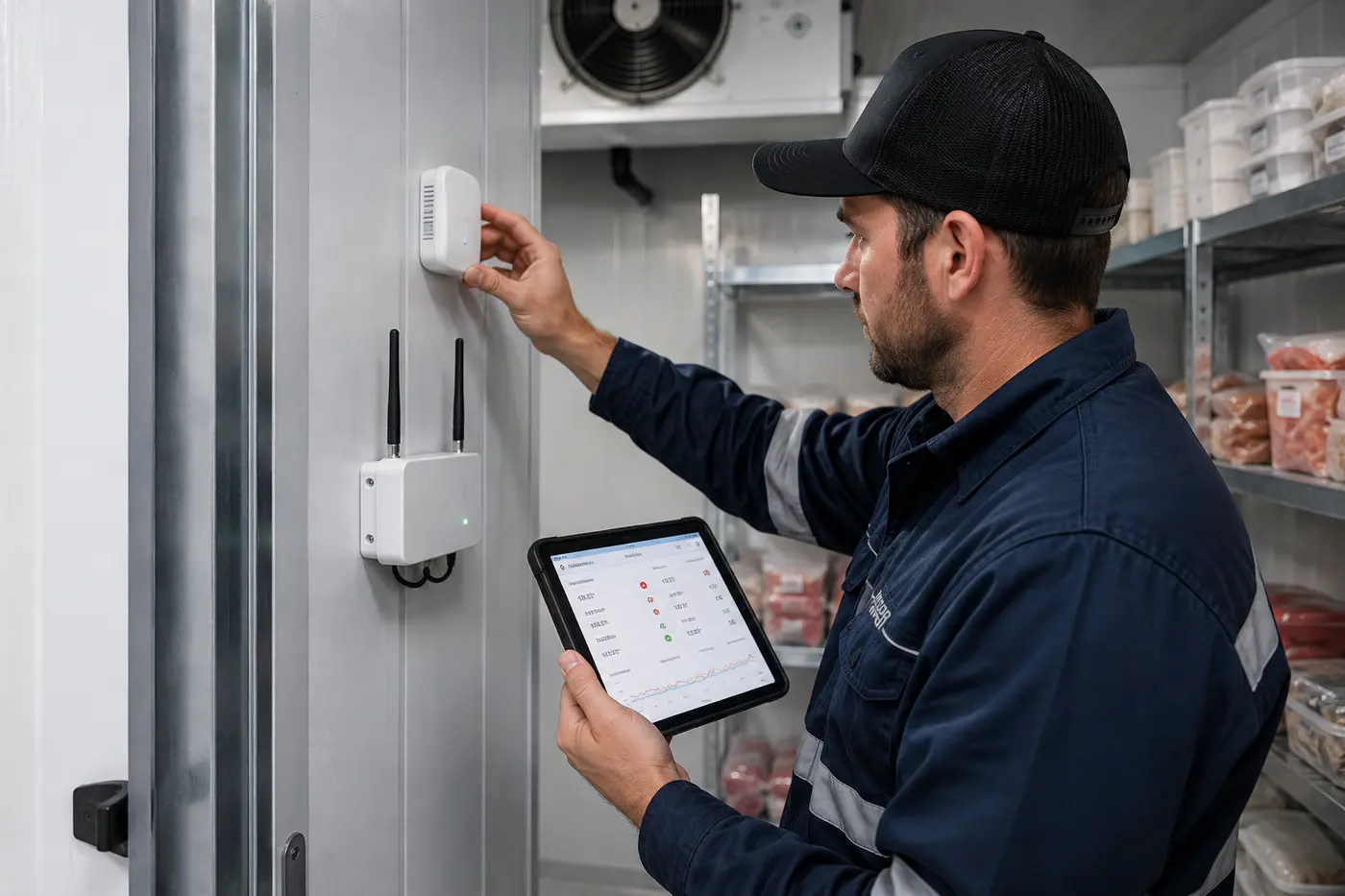
Smart monitoring transforms refrigeration management from reactive to proactive. Wireless sensors inside every cold room and display case transmit temperature data to a cloud dashboard every few minutes. If temperature rises above your threshold, an SMS and email alert is sent immediately.
Discuss Your NeedsKey Benefits
- Wireless sensors — no cabling, fast installation
- Real-time cloud dashboard accessible from any device
- Customisable SMS and email alerts by threshold
- Automated HACCP-ready temperature logs with timestamps
- Historical data and trend analysis
- Multi-site management from a single dashboard
How It Works
Site Assessment
We identify monitoring points — cold rooms, display cases, freezers — and specify the right sensors.
Installation
Wireless sensors installed and calibrated. Platform configured with your alert thresholds.
Dashboard Setup
Your team is onboarded to the cloud platform with alert contacts configured.
Ongoing Monitoring
Continuous data collection, alert management and periodic calibration checks.
Frequently Asked Questions
How quickly are alerts sent?
Alerts are typically sent within 2–5 minutes of a temperature excursion being detected.
Can I monitor multiple sites from one dashboard?
Yes. Our platform supports unlimited sites and monitoring points from a single login.
Does this replace manual temperature checks?
For HACCP purposes, automated monitoring with timestamped logs is actually more defensible than manual checks.
Refrigeration Emergency? We're On Call 24/7.
Don't lose stock to a breakdown. Call now or book a maintenance plan to prevent it happening in the first place.