 ®
®Commercial Cold Room Design & Installation QLD
Need a cold room built for your business? We design and install custom cold rooms across Queensland, built to handle demanding commercial environments. Whether you are fitting out a new site, expanding capacity or replacing an existing system, we deliver reliable, compliant solutions that perform long term.
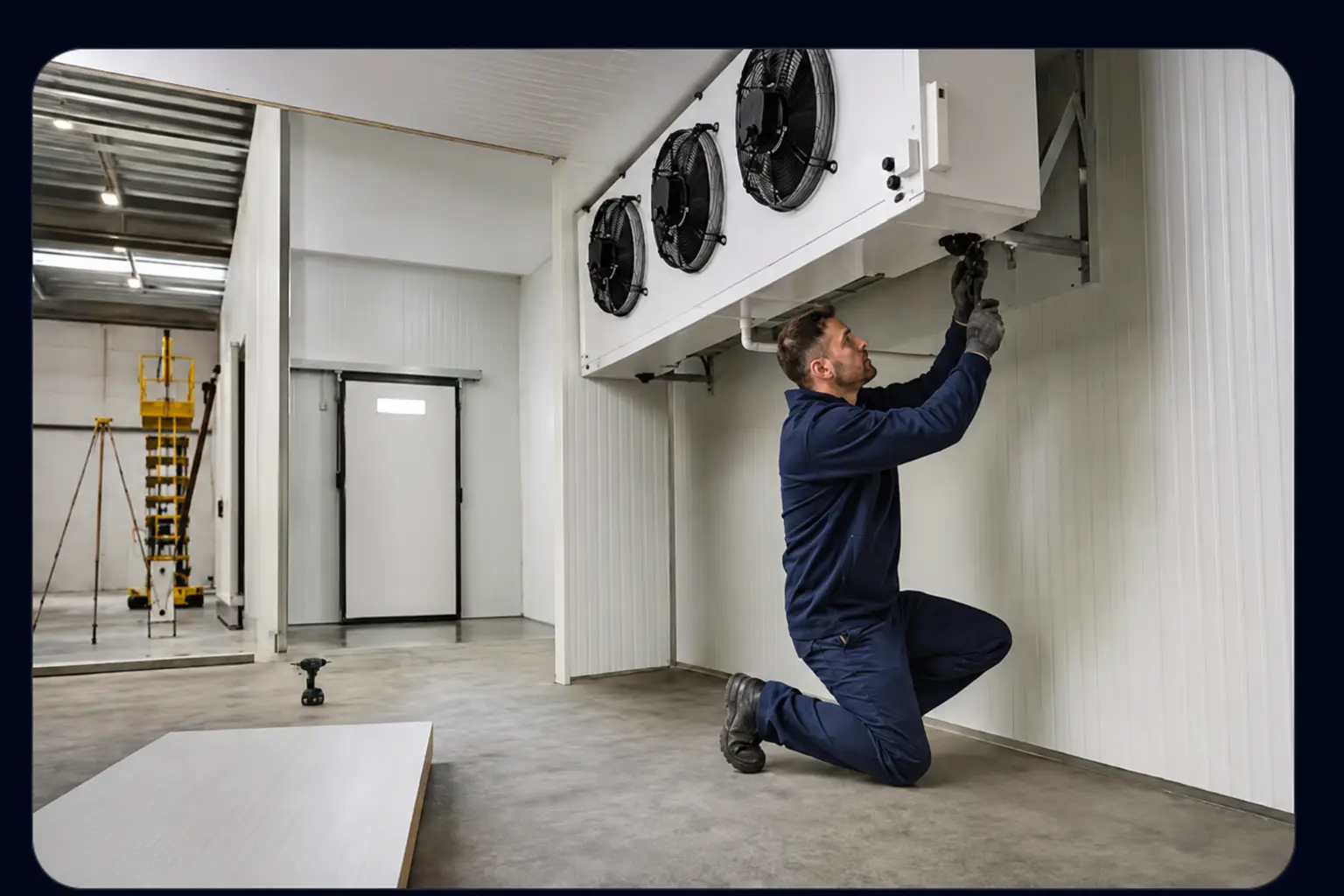
What separates a 15-year cold room from one that fails in three
Most cold room failures trace back to decisions made at the design and installation stage — not the equipment itself.
Common causes of premature cold room failure
System runs continuously trying to meet load. Compressor lifespan halved. Temperature never fully recovers after door openings.
Often the result of load calculation skipped at design stage.
EPS panels used in high-humidity or freezer applications absorb moisture over time. Insulation value degrades. Running costs rise progressively.
Panel selection must match application, not just price.
Gaps in panel connections allow warm air infiltration and condensation build-up inside the structure. Internal corrosion follows.
Particularly critical in Queensland humidity.
Condensing unit installed in poorly ventilated space. Ambient heat recirculates. System runs at elevated head pressure year-round — especially during Queensland summers.
A design decision that can't be undone without major cost.
System handed over without temperature verification or pull-down testing. Faults present from day one go undetected until a compliance issue or stock loss forces the issue.
Every ACRO build is tested and commissioned before handover.
“We're regularly asked to replace cold rooms that are five or six years old — well short of the 15-year lifespan a properly built room should deliver. In most cases the failure traces back to an undersized refrigeration system or the wrong panel spec for the application. Both are design decisions, not equipment failures.”
— ACRO design team — commercial cold room installation, Queensland
PIR, PUR or EPS — which panel is right for your cold room
Panel selection is one of the most consequential decisions in a cold room build. The wrong choice for your application increases running costs and shortens lifespan.
PIR — Polyisocyanurate
Best thermal performance
Highest of the three
More insulation per mm of panel thickness
Freezer rooms, blast chillers, applications requiring maximum insulation efficiency in limited space
Closed-cell structure — highly moisture resistant
Higher upfront. Lower running cost long term.
PUR — Polyurethane
High performance, broad application
High — slightly below PIR
Strong insulation performance across most applications
Cool rooms, coolrooms, walk-in fridges, most commercial refrigeration applications
Closed-cell — good moisture resistance for Queensland conditions
Mid-range. Best balance of cost and performance.
EPS — Expanded Polystyrene
Budget option — limited applications
Lower than PIR or PUR
Requires greater panel thickness for equivalent insulation
Low-humidity cool room applications, dry store, short-term or lower-demand installations
Open-cell structure — absorbs moisture over time. Degrades in high-humidity environments.
Lowest upfront. Higher running cost and earlier replacement cycle.
“In Queensland's climate, specifying EPS panels for a freezer room or a cool room in a high-humidity kitchen is a guaranteed long-term problem. We specify PIR or PUR on every build — the energy savings alone recover the cost difference within a few years.”
— ACRO design team — cold room panel specification, Queensland
Why Queensland conditions change how a cold room is designed
A cold room designed for a Melbourne climate will underperform in SE Queensland. Ambient temperature, humidity and seasonal load variation all affect how the system is specified.
High ambient temperature
SE Queensland summer ambient temperatures regularly exceed 35°C. Condensing units must be sized and positioned to reject heat effectively in these conditions — not just average operating conditions.
- Refrigeration systems sized to peak summer load, not average
- Condensing unit location selected to avoid heat recirculation
- High-ambient rated components specified where required
Humidity and condensation
High humidity accelerates condensation on panel joints, door seals and penetrations. Moisture ingress is the primary cause of panel degradation and structural failure in Queensland cool rooms.
- Closed-cell panel insulation (PIR or PUR) specified as standard
- All panel joints sealed to prevent moisture infiltration
- Anti-condensation heaters on freezer door frames
Door opening frequency
High-traffic commercial kitchens and hospitality venues cycle cool room doors dozens of times per service. Refrigeration load calculations must account for infiltration load — not just static storage volume.
- Infiltration load modelled against actual usage patterns
- Strip curtains or air curtains specified for high-traffic openings
- Evaporator sizing accounts for pull-down recovery time
Building integration
Retrofitting cold rooms into existing commercial kitchens, warehouses and retail spaces across Queensland requires working within structural, compliance and access constraints that vary significantly site to site.
- Site survey completed before any design work begins
- Structural loading, drain, electrical and ventilation requirements assessed
- Build sequenced to minimise operational disruption
Cold room types and configurations
From single-door cool rooms to multi-zone cold storage facilities — built to the specification your operation requires.
| Type | Temperature range | Common applications | Key design considerations |
|---|---|---|---|
| Cool room | +1°C to +4°C | Commercial kitchens, hospitality, food retail, aged care | Door frequency, infiltration load, humidity management |
| Freezer room | −18°C to −22°C | Food production, cold storage, wholesale, ice cream | PIR panel spec, anti-condensation heaters, defrost cycle design |
| Coolroom / freezer combo | Dual zone | Hotels, large kitchens, food service, catering | Shared wall insulation, independent refrigeration circuits |
| Blast chiller room | Pull-down to +3°C | Cook-chill operations, food production, institutional catering | High-capacity evaporator, fast pull-down spec, HACCP probe points |
| Coolroom with pass-through | +1°C to +4°C | Hospital pharmacies, food service, high-throughput kitchens | Dual door alignment, infiltration control, traffic flow design |
| Multi-zone cold storage | Multiple setpoints | Food production, distribution, healthcare | Independent refrigeration per zone, BMS integration, compliance documentation |
“Every build starts with understanding what the room actually needs to do — how often the doors open, what product is being stored, what the ambient conditions are and what compliance the client operates under. The spec follows from that, not the other way around.”
— ACRO design team — commercial cold room installation, Queensland
What's Included
From single-door coolrooms to multi-zone freezer facilities, we handle every stage — site survey, engineering design, panel fabrication, refrigeration fit-out and commissioning. All builds use PIR or PUR or EPS panel insulation and food-grade finishes to suit your cold storage needs.
Get Your Cold Room Built RightKey Benefits
- Custom-designed to suit your operation and space
- Built to perform in Queensland conditions
- Reliable temperature control for food safety and compliance
- Designed for energy efficiency and long-term running costs
- Suitable for hospitality, retail, healthcare and food production
- One contractor managing design, build and installation
How It Works
Initial Consultation
We discuss your requirements, site conditions and operational needs to understand exactly what the system needs to deliver.
Site Assessment
A technician attends site to assess layout, access, space and installation requirements.
System Design
We design a cold room tailored to your application, including sizing, refrigeration load and configuration.
Quote & Approval
You receive a clear proposal outlining scope, specifications and pricing for approval.
Installation
Our team installs the cold room, including panels, refrigeration system and electrical components.
Commissioning
The system is tested and commissioned to ensure correct operation and temperature control.
Frequently Asked Questions
How long does it take to build a cold room?
Timeframes vary depending on size and complexity, but most commercial cold room installations are completed within a few weeks from approval.
Can you retrofit into an existing space?
Absolutely. We specialise in retrofitting cold rooms into existing commercial kitchens and warehouses.
Do you design cold rooms to suit specific businesses?
Yes. Every cold room is designed based on your site, usage requirements and industry standards to ensure reliable performance.
Can you replace an existing cold room?
Yes. We can assess your current system and design a replacement that improves performance, efficiency and compliance.
Do you handle the full installation?
Yes. We manage the entire process including design, supply, installation, refrigeration and electrical work.
What industries do you work with?
We work with hospitality, retail, healthcare, food production and other commercial operations requiring reliable temperature-controlled environments.
Related Services
Related Resources

Need a Cold Room Built? Call Now
We design and build custom cold rooms for commercial use. Call now to discuss your project and get a fast, accurate quote.